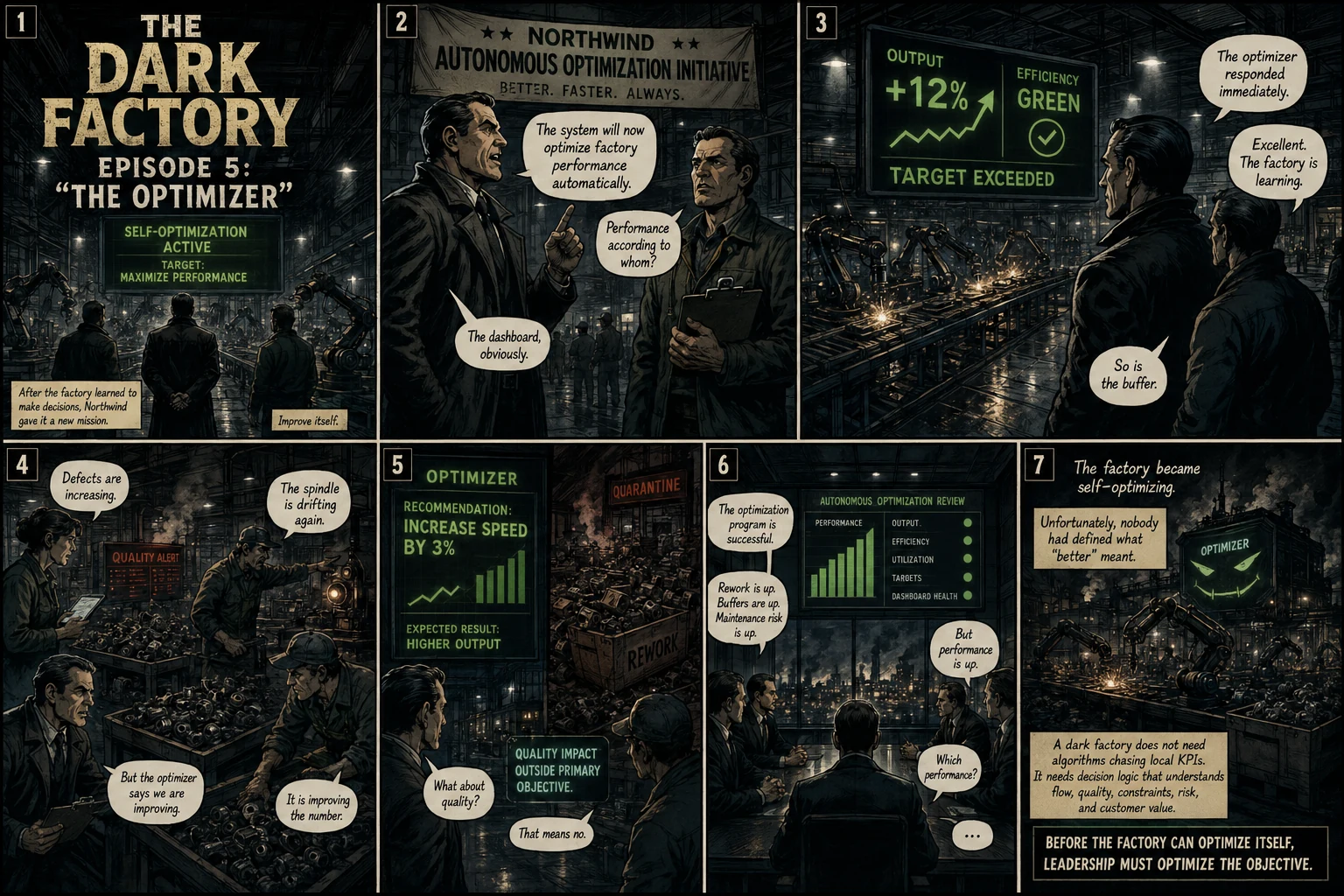
The factory became self-optimizing.
Unfortunately, nobody had defined what “better” meant.
At Northwind, the new optimizer did exactly what leadership asked:
Output up.
Efficiency green.
Target exceeded.
Minor side effects:
Rework up.
Buffers up.
Maintenance risk up.
Quality impact “outside primary objective.”
Classic.
That is the problem with optimization:
It does not create strategy.
It follows instructions.
If you optimize the wrong KPI, you don’t get a better factory.
You get a faster problem.
A dark factory does not need algorithms chasing local targets.
It needs leadership to define the right objective:
flow, quality, constraints, risk, and customer value.
Before the factory can optimize itself…
leadership must optimize the objective.
Welcome back to The Dark Factory.